

Tutorial Schedule
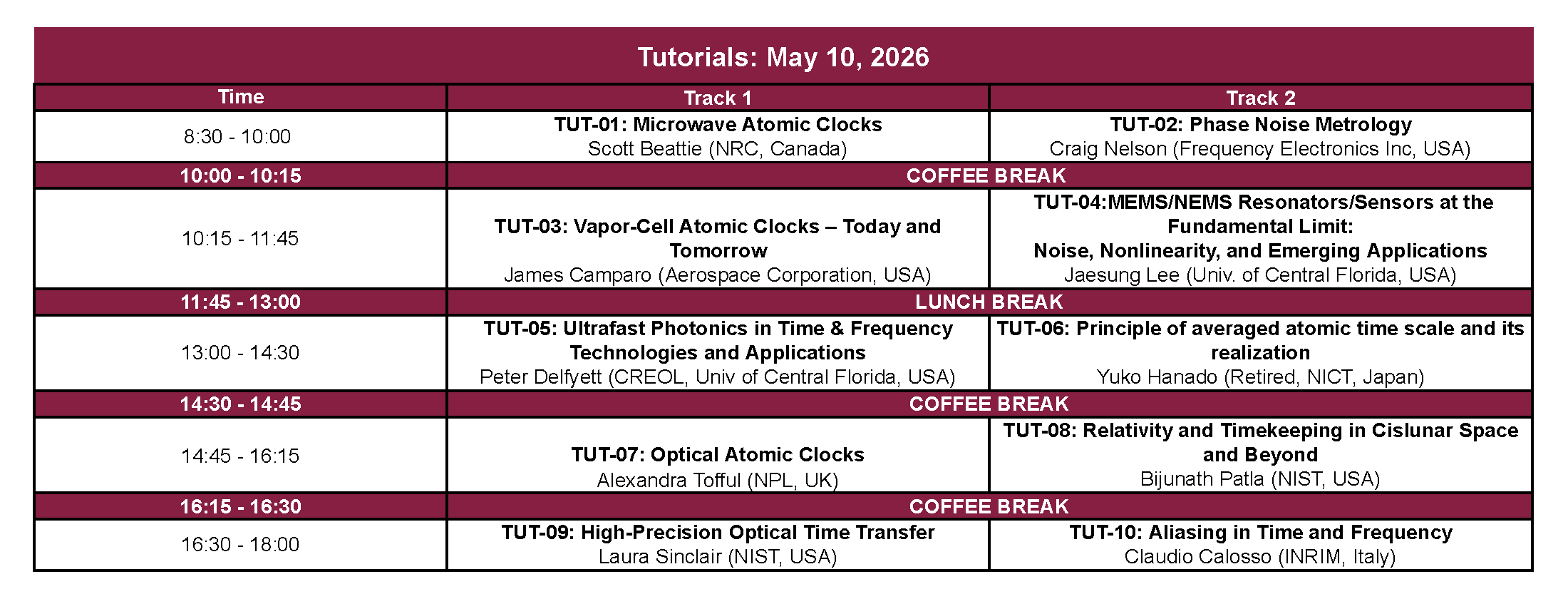
*Schedule is subject to change
Sunday, May 10, 2026
The tutorials at IFCS 2026 will feature lecturers that are on-site in Tampa and available to answer in-person questions. The tutorials will take place on Sunday, May 10, 2026.
All tutorials will be recorded and made available on the conference online platform shortly afterward. They can be viewed up to 30 days after the end of the conference, both by virtual attendees that registered for the tutorials, and in-person tutorial participants that want to refresh their memory or catch up on a lecture they missed.
No live streaming will be available this year to manage the cost of attendance. A dedicated discussion forum for each tutorial will provide an opportunity to contact the lecturers with questions.
*Schedule is subject to change
Microwave atomic clocks have underpinned frequency and time metrology for more than half a century and have reached a level of maturity that enables highly reliable and robust operation. They span a wide range of implementations and performance levels, from space-qualified clocks to laboratory-based atomic fountain clocks. This tutorial will present an overview of the fundamental principles of microwave atomic clocks and the key physical mechanisms governing their operation. I will review their performance in terms of stability and accuracy, with discussion of the most significant systematic frequency shifts. The tutorial will explore the range of microwave clock technologies and applications, including commercial systems such as thermal beam clocks and masers, as well as laboratory systems such as fountain clocks and trapped-ion clocks. Finally, I will address the central role of microwave clocks in global timekeeping and discuss their evolving role in the SI system as the community moves toward a possible redefinition of the second.
The exceptional accuracy of optical clocks is at the basis of the future redefinition of the SI second in terms of an optical frequency. Optical clocks are extraordinary metrological tools which also have applications beyond timekeeping. This tutorial will focus on the principles of optical clocks and their operation, and will give an overview of clock systems based on ions and neutral atoms, comparing their advantages and limitations. We will investigate the challenges of pushing the systematic and statistical uncertainty of optical clocks down to the 10-18 level and below. Next, we will look into the requirements for the optical redefinition of the second, and discuss the international efforts to carry out regular international clock comparison campaigns to satisfy these criteria. Finally, we will talk about some of the applications that make use of these state-of-the-art frequency metrology systems - from testing fundamental physics to relativistic geodesy.
Relativistic effects determine the rate and accumulation of time for clocks operating
beyond low Earth orbit. In cislunar space, gravitational and kinematic contributions from
the Earth, Moon, and Sun produce measurable offsets and variations that must be
modeled to define and compare time and frequency across Earth–Moon and
interplanetary distances. This tutorial presents a relativistic formulation of timekeeping
applicable to cislunar and interplanetary environments, building on concepts familiar
from terrestrial and GNSS-based systems. The relationship between proper time and
coordinate time is reviewed, together with the time scales and reference frames used in
precision timekeeping. Expressions for clock rate offsets, secular terms, and periodic
variations are developed for clocks in orbit. The formulation is applied to practical
timekeeping problems, including clock synchronization, time transfer, and distributed
clock networks. Examples include lunar clock systems and extensions to Mars, which
maintain continuity with existing GPS timekeeping principles and their application
beyond Earth. Throughout the tutorial, relativistic concepts are simplified into forms
suitable for implementation, with emphasis on clarity, consistency, and physical
interpretation.
Resonant micro- and nano-electromechanical systems (MEMS and NEMS) have become versatile platforms for a wide range of applications, including precision sensing and frequency-control technologies. While MEMS resonators have matured into highly robust and widely deployed devices, continued scaling into the nanoelectromechanical (NEMS) regime fundamentally reshapes the balance among noise, dynamic range, frequency stability, and overall device performance. In particular, the strong reduction in effective mass combined with increased resonance frequencies makes NEMS especially attractive for frequency-based sensing applications, where thermomechanical noise and frequency fluctuations define the ultimate performance limits. This tutorial focuses on the physical principles governing NEMS resonators, emphasizing how scaling from MEMS to NEMS alters noise transduction, nonlinear dynamics, frequency stability, and other device performance.
We begin by reviewing fundamental device performance as a function of scaling. Starting from the Langevin equation of motion, we introduce thermomechanical noise, its origin, and its derivation. The tutorial then examines resonator operation at large vibration amplitudes beyond the onset of linear behavior. In particular, we discuss the role of geometrical nonlinearity, which constrains the usable dynamic range in both MEMS and NEMS but becomes increasingly prominent in NEMS due to strong motion-induced stiffness modulation. These effects are analyzed across different length scales and built-in tension conditions to enable a direct comparison between MEMS and NEMS resonators.
Building on these concepts, we discuss how thermomechanical displacement noise and nonlinear dynamics set the ultimate performance limits of sensors and oscillators. We show how thermomechanical motion translates into frequency fluctuations through the resonance response, quality factor (Q), and available dynamic range, establishing a direct connection between mechanical noise, Allan deviation, and oscillator stability metrics. From a scaling perspective, larger MEMS resonators benefit from reduced thermomechanical noise and a higher onset of nonlinearity, enabling excellent frequency stability and robust frequency references. However, their larger effective mass and stiffness typically reduce responsivity to external perturbations when operated as frequency-based sensors. In contrast, NEMS resonators offer enhanced responsivity to external forces, masses, and fields, enabling high-performance sensing, albeit often with increased frequency noise that must be carefully managed through design and operating conditions.
Finally, we explore nonlinear NEMS operating near the quantum regime, where high resonance frequencies and ultra-low effective mass enable access to quantum noise in strongly nonlinear systems. These regimes open new opportunities for ultra-stable oscillators, frequency references, and next-generation sensors that bridge classical MEMS performance with emerging quantum-limited operation.
This tutorial covers the fundamental concepts in the generation, modulation, multiplexing, transmission and measurement of optical signals with temporal durations of picoseconds to attoseconds. Applications of these signals in areas of time and frequency metrology will also be covered. The goal of the tutorial is to have the participant become proficient in understanding technical literature in areas that develop and use ultrafast photonic technologies for scientific and commercial applications.
With the advent of microwave and optical metrology, time- and frequency signals increasingly exhibit fast noise and spectral bumps, which were usually negligible in traditional radio-frequency domains. As a result, significantly more power is found at high Fourier frequencies, which can compromise stability analysis and noise measurements through aliasing — the folding of out-of-band noise and bumps into the measurement bandwidth — at various stages of acquisition and processing.
This tutorial reviews aliasing from a metrological perspective, covering measurements — essentially analog-to-digital conversions — the associated analysis methods (PSD, Allan variances), instruments (counters, phasemeters, and frequency meters), atomic clocks (Dick effect and detection noise), frequency dividers, frequency combs, and intentional undersampling.
Practical examples show how inadequate bandwidth control or sampling can worsen the noise floor, degrade stability, or yield misleading estimates, and how proper filtering and careful signal handling can prevent such errors.
This tutorial will focus on “warm-vapor” atomic clocks, that is frequency standards whose atomic reference is created in a vapor of atoms near room temperature (i.e., from roughly 30 oC to no more than about 100 oC). Since the predominance of warm-vapor atomic clocks are microwave frequency standards, these will be the focus of the tutorial. Nevertheless, there will be a brief digression into optical clocks based on warm-vapor quantum systems. Since the frequency shift of a warm-vapor atomic clock cannot (in general) be computed from first principles, these devices are routinely classified as secondary standards: their frequency cannot be used to define the second. However, their frequency can be calibrated to a primary standard, and since the frequency drift rate is often low, they can function as something like a “quasi” primary standard for many applications.
Following attendance of this tutorial, the attendee can expect to have gained the following:
Noise is everywhere. Its ubiquitous nature interferes with or masks desired signals and fundamentally limits all electronic measurements. Noise in the presence of a carrier is experienced as amplitude and phase modulation noise. Modulation noise will be covered from its theory, to its origins and consequences. The effects of signal manipulation such as amplification, frequency translation and multiplication on spectral purity will be examined. Practical techniques for measuring AM and PM noise, from the simple to complex, will be discussed. Typical measurement problems, including the cross-spectrum anti-correlation, will also be covered.
High-precision optical time and frequency transfer is accomplished by a collection of laser-based techniques that achieve time dissemination with sub-picosecond instabilities and frequency dissemination with instabilities below one part in 1016. This tutorial will cover a wide-range of these approaches. First, this tutorial will first present a brief review of the various technical noise sources present. Second, it will then cover specific time-frequency transfer techniques and demonstrations of time and frequency transfer over fiber-optic links including continuous wave (CW) laser-based frequency transfer, CW-laser-based time transfer, and frequency-comb-based time transfer. Third, it will then discuss approaches for time and frequency transfer over free-space including pulsed-source time transfer, CW-laser-based frequency transfer, and frequency-comb-based time transfer. Finally, it will provide an outlook that outlines outstanding challenges in the field as well as possible future applications. This tutorial will also identify technical talks for the next three days of IFCS relevant to high-precision optical time transfer.
Atomic clocks have become important in establishing stable timescales due to their exceptional precision and accuracy. However, to maintain the continuity of timescale, we must address the issues arising from the lifespan or malfunction of these clocks. One solution to this problem is to introduce a virtual timescale based on the average of an ensemble of atomic clocks. This method has several advantages: it preserves the continuity of time unless all the clocks stop working, and the averaging effect smooths out the fluctuations of individual clock.
This tutorial introduces a practical method for constructing this averaged atomic timescale at first. I start with a simple approach to understand the principles, and then show a more refined and practical calculation that can address the problems in the simple approach. Next, I present how this virtual atomic timescale is realized as a continuous output of a frequency signal, which is required in actual measurements and real-time time scales. This realization concept also gives an idea for constructing robust atomic time systems using distributed clock networks.